
A Shareable Resource for Grassroots Crisis Support & Mutual Aid
Flocking Towards Justice, Support Pods In Action

Dear Readers - First of all, my sincere apologies for being so delinquent with this newsletter in recent months. Working way more than full time, community care, and trying to stay in some semblance of health amidst the times has taken its toll, as it has for many. I’m trying to get back in the newsletter game!
The paragraphs below are an introduction to a shareable resource I developed based on Transformative Justice innovator Mia Mingus’ "Pod Mapping” model to support grassroots community-based crisis intervention. If you would prefer to go straight to the resource, here it is: https://ariseembodiment.org/wp-content/uploads/2026/01/Flocking-Towards-Justice-Support-Pods-In-Action.pdf

As I write this, the crises of our times have continued to spiral and plunge towards collapse. The global order established after the Second World War is rapidly unraveling, thanks in large part to the global resurgence of open technofascism and its triumph over global neoliberalism, both systems of domination and exploitation that never served the majority of people living on this planet. At this moment, my heart is crying out for people in the US being subjected to kidnapping and murder by ICE, for the people of Iran and the massacres that have recently occurred there, for Venezuela and Palestine and Congo and so many other places.
At this moment, as a cultural worker and practitioner of Healing Justice and Transformative Justice, I find myself wondering what I can offer in this moment to the communities and social movements that I love. Solidarity, liberation, and healing for the sake of collective human flourishing in the face of repression are my aims. More and more, I find myself thinking in terms of solidarity, coalition-building, and class war rather than identity politics (though identity remains an important frame of analysis for me) or “equity and inclusion” within capitalist systems. The times have changed dramatically since the Millennial activists of my age cohort came of political age in the 2010s. Now is, as everyone keeps quoting Gramsci, “the time of monsters” - the veil of the a benevolent world order rooted in “human rights” and benevolent billionaires has fallen. The war against fascism is erupting in earnest (and for some communities, began long ago). Never has the framework of “DEI” been less adequate for the struggle at hand.
There is definitely cause for hope, and many examples of resilience to draw inspiration from. A general strike and mass resistance to ICE in Minnesota, for example, has reminded many of the power of local organizing, and the strategies that have successfully worked to resist imperial domination for the past century: Highly localized organizing rooted in relationships between common people. Decentralized networks of coordinated action based on affinity rather than identity or rigid political theory. Movements with many leaders, united by the common denominator of simple yet powerful demands.
I’m going to keep thinking about the role of the cultural worker and healing practitioner over the next weeks and months - what can we offer that is really helpful? More potent than “somatic nervous system regulation” or vague words about “revolutionary love” (both of which I’ve been guilty of peddling in the past, and will no doubt joyfully peddle again in the future). But what’s tangible and useful right now?
One tool I’d like to share here is a basic framework for organizing decentralized, deprofessionalized crisis support care. It’s my own adaptation of Mia Mingus and the Bay Area Transformative Justice Collective’s Pod Mapping model, a framework widely referenced in North American social movement spaces. Mingus has wisely left the model open to many forms interpretation in practice, stating that “it has been wonderful to watch the concept of pods be applied in all different kinds of ways, some of which include: navigating the COVID-19 pandemic, assisting incarcerated and formerly incarcerated folks, supporting queer and trans youth, and access for disabled people.” I am very grateful to Mia Mingus for this incredible tool.
The adaption of the “pod” concept I am sharing here comes from the first time I used it as a support for myself during a period of severe mental health crisis related to traumatic violence I experienced within my own community. This adaptation, which I have broken down into (optional) linear steps is heavily oriented towards providing stabilization and support in times of crisis. It can be used to generate greater safety and protection for individuals who are at risk who are facing:
Violence within their own communities, such as intimate partner violence or harassment)
External threats, such as mobbing or online doxing from bad political actors or profiling by oppressive authorities
Mental health crises such as sudden onset psychosis or suicidality
In keeping with the model’s roots in Transformative Justice, a philosophy/praxis that is abolitionist and non-carceral, this adaptation of the support pod has been developed explicitly to be useable by individuals who need help but cannot or do not wish to, for all the many reasons, engage with the policing or criminal justice system.
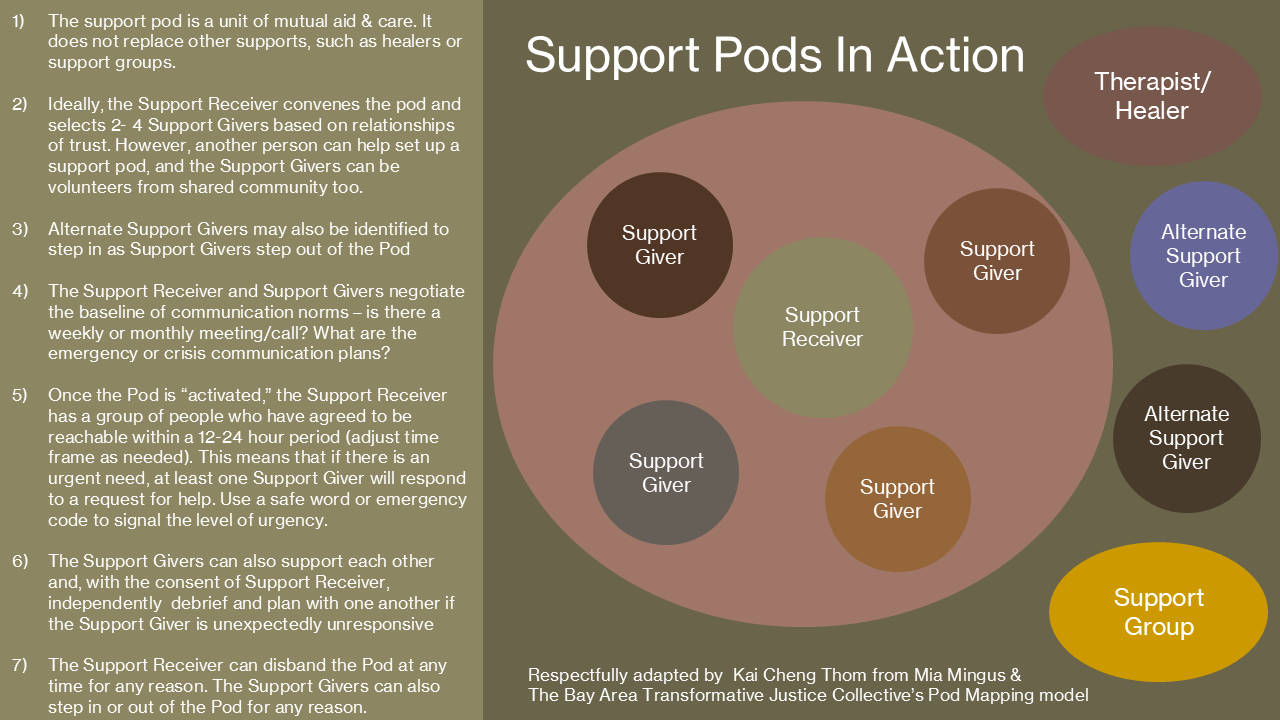
A template for putting a Support Pod together. This template is meant to be taken as a suggestion and not a set of “rules.”
As our local governments continue to actively destroy state-based social welfare networks, it will become increasingly important for us - not just activists, but everyone - to hone and develop our ability to respond to crisis without relying on professionalized, corporatized institutions such as the police or the medical-industrial complex (while also acknowledging that high-quality health care is a human right). Constellations of social change work are likely to find themselves in increasing need of strategies for caregiving, healing, conflict transformation, and justice-seeking that do not place them in direct contact with state surveillance.
I also think it relevant to share that I created this resource partially because of the sheer volume of requests I’ve gotten from activists and social justice-oriented public figures all over the world for the past ten years fervently seeking help and practical strategies for responding to critical incidents within their communities. These tend to come in two forms:
1) An activist has experienced conflict or abuse from someone else in their activist circle and is experiencing trauma, fear, and confusion about how to respond. They may also have experienced gaslighting or abandonment from people they considered chosen family or dear comrades. They don’t want to engage with punishment, call-out/cancel culture, or criminal justice, but they also feel terrified and unsure of how to keep participating in their community.
2) An activist has been accused of abuse or harm by someone else in their activist circle and is experiencing trauma, fear, and confusion about how to respond. They may also have experienced public humiliation or abandonment from people they considered chosen family or dear comrades. Sometimes, they know that they have genuinely done something wrong, but sometimes they wonder if that is in fact true - if perhaps they are actually being gaslit by someone who is really abusing them. They don’t want to perpetuate harm, but they are wondering how to maintain their boundaries and relationships.
And indeed, these two scenarios can sometimes so closely overlap that it becomes difficult to tell which is which. As any mediator working in social justice communities over the past decade can tell you, it has now become increasingly common for the roles of survivor and perpetrator to become highly contested within a given situation.
The pod strategy allows us to step back, momentarily, from the question of who is “guilty” and who is “innocent.” It allows us instead to focus on a core human need - connection and belonging, a need that is essential to the work of transformation and healing from violence and trauma.
The surge of creative and powerful resistance in the uprisings currently springing up is inspiring and life-giving. It is my hope that this resource can be one small addition to the wellspring of strategies to support that swelling of the people’s power.
Work from innovators and thinkers in the Transformative Justice field that I would like to highlight here include:
Mia Mingus & The SOIL Project: As stated above, Mia Mingus is the innovator of the “Pod/Pod Mapping” model now widely integrated into Transformative Justice worldwide. The SOIL project provides many more details on the concept of “pods” and many different ways that pods can be used - https://www.soiltjp.org/
The Bay Area Transformative Justice Collective: https://batjc.org/
Mariame Kaba & Shira Hassan’s Fumbling Towards Repair: A Workbook for Community Accountability Facilitators
Ejeris Dixon & Leah Lakshmi Piepzna-Samarasinha’s anthology Beyond Survival: Strategies and Stories from the Transformative Justice Movement
Thank you for this rich and much needed resource. The lines blurred between who was right and wrong feel more and more subjective to me as conflict has taken up more space in my life this past 2 years since trying to intentionally be apart of social justice communities. I think this really meets us where we're at. Appreciation for reading the moment and responding with additional resources as well. Take care 🥰
Thanks for expanding upon / deepening the Pod framework. I find this additional layering incredibly helpful, and I will definitely be sharing it with others I am currently co-creating alongside. The more we have tools that aid Us All in reorienting towards Power With (and away from Power Over) the better.